Easy Gluten Free Sourdough Bread in the Bread Machine
This soft and squishy gluten free and dairy free sourdough bread is delicious paired with a soup and salad or used as sandwich bread or toast for breakfast! New to sourdough? Sourdough is easier than you think! I’ll teach you! I love this recipe because there are no extra bowls or dishes to wash; You just add all the ingredients to your bread machine and let it do the work for you!!

I LOVE sourdough!
I love the taste, fluffiness and best of all, the nutrition of sourdough! It is amazing for your health by breaking down the phytic acid in the grains and making it easier to digest and assimilate the vitamins and minerals in the bread.
Another benefit in sourdough is the money-savings!
You won’t need to buy yeast ever again! It is the gift that keeps on giving! Just add equal parts of gluten free flour (like organic brown rice flour) and filtered water and it “eats” the grain and breaks it down.
It’s actually a simple process to maintain an active sourdough starter. People want to complicate it and make it sound super confusing, but it’s truly not.
So here’s the jist about sourdough: If you are going to make something with it, you’ll need to “feed it” the morning of or the night before and wait for it to get “active and bubbly” in the jar. The flour and water mixture will rise in the jar and get bubbles in it. Then, it’s considered active. If it’s unfed, it’s considered a “discard” recipe. That’s it.
How do you feed your sourdough starter?
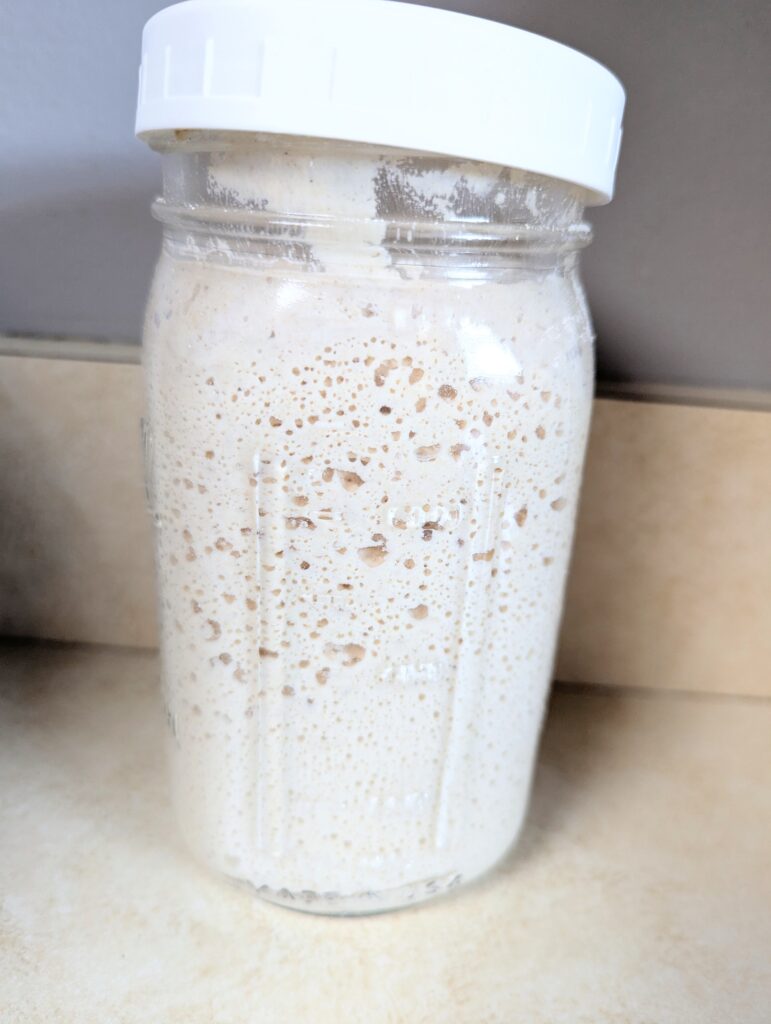
This is assuming you have a starter or were given a starter. Now what? The starter needs to have 2 things: gluten free flour, like brown rice, white rice, millet, or sorghum AND filtered water. You will need to feed it equal parts gluten free flour and water. You want the consistency of the starter to be like a thick pancake batter. Feel free to tweak it a bit. Seems too thick, add more water. Seems too runny, add more flour.
How much do I feed it?
I typically feed it as much as I am going to need in the recipe. So if my recipe calls for 1/2 cup of starter, I will feed it a 1/2 cup of gluten free flour and 1/2 cup of water. If you are going to use it for more recipes in the next day or 2, feed it more. Let it sit on the counter and then wait for it to get bubbly and rise in your jar. I use a quart mason jar with a loose plastic lid. You want to let it get exposed to the air- no tight fitting lids.
What if my sourdough isn’t super bubbly? Can I still use it in the recipe?
Yes, you can. It just means it may take it longer for your bread to rise in the recipe. So, you fed your sourdough the day before and it’s looking rather flat and not many bubbles? Yes, you can still use it. I use mine that way all of the time and still get great results with breads and cookies. Once you make the bread dough, that sourdough starter is excited because you are feeding it and it’s going to activate itself again. I hope that makes sense. 🙂
What if I won’t use it for awhile?
If you know you won’t be making anything with it for awhile, feed it some gluten free flour and water and then place it in the fridge with a tight fitting lid. It will keep in the fridge for weeks or even months. I’ve been known to neglect mine for a month and it’s still fine. Just pour off any water that floats to the top and feed it some gluten free flour and water and leave it on the counter at room temperature to reactivate it.
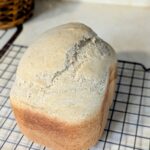
Easy Gluten Free Sourdough Bread in the Bread Machine
Equipment
- Bread Machine Use the French bread setting or the setting with the longest rise times
Ingredients
- 1/4 cup avocado oil or neutral flavored cooking oil
- 1 1/2 cups warm water *plus additional water to get the right consistency you may need to add more water to get the right consistency to the bread dough once it starts kneading in the machine
- 2 tbsp Psyllium Husk Flakes
- 2 tbsp honey or agave
- 3 large eggs or equaling 3/4 cup of eggs
- 1 cup active sourdough starter ideally fed the same day or day before for best rising results *see notes
- 3 1/2 cups gluten free flour blend with xanthan gum OR 2 1/2 cups of brown rice flour and 1 cup tapioca starch plus 1 tsp xanthan gum this can be freshly milled flour or prepackaged
- 1/2 tsp sea salt
Instructions
- Add the oil, 1 1/2 cups of warm water, psyllium husk flakes, eggs, honey and sourdough starter to the bottom of the bread machine loaf pan. then add the rest of the dry ingredients.
- Place the pan in the bread machine and set on the French Bread Setting, 2 lb loaf. You want the setting with the longest rise times. Basic and the gluten free settings do not have adequate rise times. The longer the better! If your bread machine doesn't have a French bread setting, do some research on your particular machine and see what has the longest rise time. The French bread setting on my machine rises for 40 minutes for the first rise, then 30 minutes for the second rise and 1 hour for the third rise. Then it bakes for 1 hour and 5 minutes. 3 hours 50 minutes total time in the bread machine (that factors in the kneading time too).
- Press start and it will begin kneading your dough.
- As it kneads your dough, scrape down the sides of the bread pan so the dough gets fully stirred in. The bread dough should be the consistency of thick pancake batter, so if your bread dough is too thick, add 1-2 Tablespoons of water at a time while it's kneading until you get the right consistency. Thick pancake batter, but not dry. You may need to check in 5 minutes to make sure the dough is coming together. If it still looks too dry, add a bit more water.
- Once the consistency is thick pancake batter, let the bread machine do it's thing!
- The French bread setting will take about 3 hours and 50 minutes. If your bread machine has a gluten free cycle setting, you can try it. I have found that the French bread setting to work the best. Once complete take it out of the machine using oven mitts. It will be very hot.
- Allow to cool in the pan for 5 minutes.
- Take the loaf out and allow it to cool completely on a cooling rack before slicing it. If you cut it too soon, it will be gummy. As for most GF breads, you need to let it cool completely.Enjoy!!
Notes
*Active Sourdough starter should be fed the day you make the bread or the day before. It should be bubbly and active.
What does it mean to “feed” your starter?
It just means that you have given your starter some new flour to “eat” and ferment to keep the fermentation process alive and active. You want to add equal parts GF flour and filtered water to your starter.When to feed your starter:
I typically feed mine about 1 cup of brown rice flour and 1 cup of filtered water at a time a couple hours before I am going to use it. You could also feed it the night before you will be making this bread. If it hasn’t been fed in awhile, like you had it in the fridge for several days, you may need to feed it and then let it sit on the counter for a few hours before it gets some bubbles. Bubbles are a great sign that it’s active, alive and healthy!The consistency of a GF sourdough starter should be that of a thick pancake batter. If it’s too runny, just add a bit more GF flour. If it’s too thick, add a bit of water.